240-Hour Visa-Free Transit China 2026: The Complete Guide
240-Hour Visa-Free Transit China 2026: The Complete Guide
Last updated: April 2026
Good news: you might not need a visa to visit China.
China's 240-hour visa-free transit policy lets citizens from 55 countries stay up to 10 days without a visa. No embassy visits. No application fees. Just show up with the right documents.
But it's not a free pass — use it wrong and it could hurt future visa applications. Here's everything you need to know.
What Is the 240-Hour Visa-Free Transit?
It's a policy that allows eligible travelers to transit through China and stay for up to 240 hours (10 days) without a visa. The key word is transit — you must be traveling between two different countries.
Example: Flying from Tokyo → Shanghai (stay 8 days) → Seoul ✅
This works because you're transiting through China on your way from Japan to South Korea.
Doesn't work: Flying from Tokyo → Shanghai → Tokyo ❌
That's a round trip, not transit. You must enter from one country and exit to a different country.
Core Requirements
You must satisfy all of these conditions:
- Nationality: Citizen of one of the 55 eligible countries
- Valid passport: At least 3 months validity remaining
- Transit itinerary: Enter from Country A, exit to Country B (must be different)
- Connecting tickets: Confirmed through-tickets with fixed dates and seats for your entire journey (flights, trains, or ships)
Who Is Eligible?

Citizens of 55 countries can use this policy:
Europe (40 countries)
Austria, Belgium, Czech Republic, Denmark, Estonia, Finland, France, Germany, Greece, Hungary, Iceland, Italy, Latvia, Lithuania, Luxembourg, Malta, Netherlands, Poland, Portugal, Slovakia, Slovenia, Spain, Sweden, Switzerland, Monaco, Russia, United Kingdom, Ireland, Cyprus, Bulgaria, Romania, Ukraine, Serbia, Croatia, Bosnia and Herzegovina, Montenegro, North Macedonia, Albania, Belarus, Norway.
Americas (6 countries)
United States, Canada, Brazil, Mexico, Argentina, Chile.
Oceania (2 countries)
Australia, New Zealand.
Asia (7 countries)
Japan, South Korea, Singapore, Brunei, United Arab Emirates, Qatar, Indonesia.
Where Can You Go?
Under the 240-hour policy, you can travel across 24 provinces (regions and municipalities) in China with cross-province travel allowed within the designated areas. This is a major upgrade from the old 144-hour policy — you're no longer locked into a single city.
Major Entry Points
| Entry Point | Airport/Port Code | Region Access |
|---|---|---|
| Shanghai Pudong / Hongqiao | PVG / SHA | Yangtze Delta (Shanghai, Jiangsu, Zhejiang) |
| Beijing Capital / Daxing | PEK / PKX | Beijing-Tianjin-Hebei |
| Guangzhou Baiyun | CAN | Guangdong Province |
| Chengdu Tianfu | TFU | Sichuan, Chongqing |
| Chongqing Jiangbei | CKG | Chongqing, Sichuan |
| Xi'an Xianyang | XIY | Shaanxi Province |
| Hangzhou Xiaoshan | HGH | Yangtze Delta |
| Nanjing Lukou | NKG | Yangtze Delta |
| Kunming Changshui | KMG | Yunnan Province |
| Xiamen Gaoqi | XMN | Fujian Province |
| Qingdao Jiaodong | TAO | Shandong Province |
| Harbin Taiping | HRB | Heilongjiang Province |
| Wuhan Tianhe | WUH | Hubei Province |
| Changsha Huanghua | CSX | Hunan Province |
| Guilin Liangjiang | KWL | Guangxi Province |
| Dalian Zhoushuizi | DLC | Liaoning Province |
Plus additional land and sea ports in Shenzhen, Zhuhai, and others.
You can visit: 24 provinces including Shanghai, Beijing, Guangdong, Sichuan, Zhejiang, Jiangsu, Yunnan, Fujian, Shaanxi, Shandong, Hubei, Hunan, and more. Cross-province travel is allowed within the designated zones.
Cannot visit: Tibet, Xinjiang, and other areas not covered by the 240-hour policy. Always verify before planning.
What Documents Do You Need?
At the immigration counter, prepare:
- Valid passport (at least 3 months validity)
- Connecting tickets to a third country — confirmed booking with dates and seats
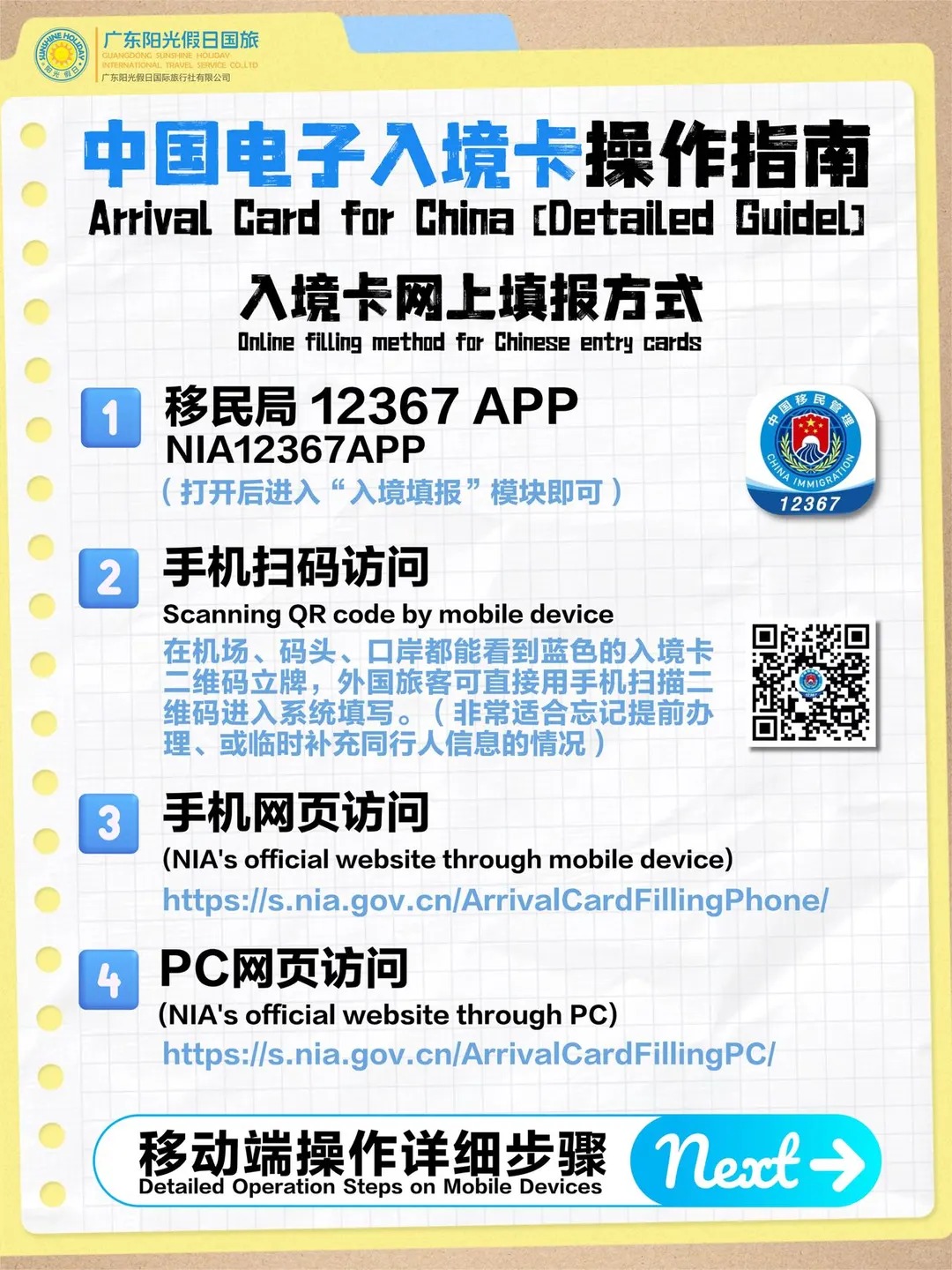
- Completed arrival card (given on plane or at airport, or fill out online in advance)
- Hotel booking confirmation (recommended — immigration may ask)
Important: The onward ticket must be to a different country than where you came from.
✅ Tokyo → Shanghai → Seoul (works) ❌ Tokyo → Shanghai → Tokyo (doesn't work) ❌ US → Hong Kong → Shanghai → Hong Kong → US (doesn't work — Hong Kong counts as same origin/return)
Step-by-Step Process
Before You Fly
- Check eligibility — Confirm your country is on the 55-country list
- Book connecting travel — You need confirmed tickets leaving China to a third country
- Check entry point — Make sure your airport/port is approved for 240-hour transit
- Prepare documents — Print your onward ticket, hotel booking, and have everything organized
- Translate key documents — Consider translating passport info, tickets, and hotel bookings into Chinese for smoother immigration processing
At Departure Airport
- Check-in counter — Show your passport and connecting tickets
- Airline verification — The airline will verify your eligibility before boarding
- Boarding — You'll be allowed to board once verified
Arriving in China
- Fill arrival card — Complete the entry card (distributed on plane or fill online). Select "240-Hour Visa-Free Transit" as your reason
- Go to immigration — Look for the "240-Hour Visa-Free Transit" counter
- Present documents — Passport + connecting tickets + arrival card
- Get stamp — Immigration stamps your passport with exit date
- Collect luggage — Pick up your bags
- Exit airport — Welcome to China!
During Your Stay
- Register accommodation within 24 hours — Hotels do this automatically. If staying with friends, visit the local police station to register
- Stay within the 24 designated provinces — Don't travel to areas outside the policy
- Keep documents safe — Carry passport copies and hotel confirmations
- Know your exit date — Time starts from midnight of the day after entry. Example: arrive August 5 at 2PM → your 240 hours run until midnight on August 15
- Only permitted activities — Tourism, visiting family, short-term business. No work, study, or journalism
Leaving China
- Arrive early — Be at airport 3 hours before departure
- Immigration exit — Show passport with entry stamp
- Depart — Fly to your next destination (must be a different country than where you came from)
Common Questions
Can I extend beyond 240 hours?
No. The 240 hours cannot be extended. You must leave before it expires. Overstaying will result in an adverse immigration record that may affect future visa applications.
Can I visit multiple provinces?
Yes! Cross-province travel is allowed within the 24 designated provinces. For example:
- Shanghai → Hangzhou → Nanjing ✅ (all in Yangtze Delta zone)
- Beijing → Tianjin → Hebei ✅ (Jing-Jin-Ji zone)
Can I work or study?
No. This is strictly for tourism, visiting family, and short-term business. Work, study, and journalism require separate visas. Violating this rule will impact future visa applications.
Do I need a hotel booking?
Not strictly required, but highly recommended. Immigration may ask where you're staying. If staying with a friend, you must register at the local police station within 24 hours of arrival.
What if my flight is delayed?
Contact immigration immediately. Delays due to weather or airline issues are generally accommodated, but you must report to immigration proactively.
Can I enter by land?
Yes, at some ports. For example:
- Hong Kong → Shenzhen (by train) ✅
- Macau → Zhuhai (by land) ✅
But you still need a connecting ticket to a third country.
How is the 240 hours calculated?
The clock starts from midnight of the day after your entry. If you arrive on August 5 at any time, your 240-hour period begins at 00:00 on August 6 and ends at 23:59 on August 15.
Pro Tips
1. Prepare Chinese Translations
Print translated versions of your passport, connecting tickets, and hotel bookings. This avoids communication issues at immigration and speeds up processing.
2. Use This for Short Business Trips
If you have a conference or meeting in Shanghai or Beijing, this saves you visa hassle. Just make sure you're transiting between two different countries.
3. Combine Multiple Cities
With cross-province travel, you can now do much more:
- Seoul → Shanghai (3 days) → Hangzhou (2 days) → Chengdu (3 days) → Bangkok This gives you 3 cities in one trip, no visa needed.
4. Register Your Accommodation Early
Don't wait — register at your hotel or local police station within 24 hours of arrival. Failure to register can cause problems.
5. Keep Digital Copies
Photos of your passport, tickets, and hotel bookings on your phone — just in case.
6. Know the Red Lines
- Transit ≠ Tourism loop: Must go from A → China → B (A ≠ B)
- Free visa ≠ Work permit: No employment or study allowed
- Overstay = Bad record: Always leave within 240 hours, no exceptions
Real Example: 10-Day China Trip
Day 0 (Aug 5): Arrive Shanghai Pudong 2PM
- Immigration: 30 minutes
- Register at hotel
- Rest
Day 1-3: Shanghai — The Bund, Yu Garden, French Concession, Nanjing Road Day 4: Day trip to Suzhou (1 hour by high-speed train) Day 5: Day trip to Hangzhou (1 hour by high-speed train) — West Lake Day 6: Fly Shanghai → Chengdu Day 7: Chengdu — Giant Panda Base, Jinli Street Day 8: Chengdu — Sichuan hotpot, Kuanzhai Alley, People's Park Day 9: Fly Chengdu → Bangkok
Total cost: ~$1,200 (flights not included) Visa cost: $0
What If I'm Not Eligible?
If your country isn't on the 55-country list, you'll need a regular visa:
- Tourist visa (L visa): Standard for tourism
- Business visa (M visa): For business activities
- Transit visa (G visa): For short transits
Apply at your nearest Chinese embassy or consulate. Processing takes 4-7 business days.
Summary
| Item | Details |
|---|---|
| Duration | Up to 240 hours (10 days) |
| Eligible countries | 55 countries |
| Passport requirement | At least 3 months validity |
| Cost | Free |
| Key requirement | Connecting tickets to a different country |
| Travel area | 24 provinces with cross-province access |
| Permitted activities | Tourism, visiting family, short-term business |
| Time calculation | Starts from midnight of the day after entry |
Need More Help?
- 📖 Alipay Setup Guide — How to pay in China
- 📖 VPN Guide — Stay connected
- 📖 Must-Have Apps — Essential apps for China
- 📖 SIM Card vs eSIM — Get connected in China
This guide is updated regularly. Last verified: April 2026. Always check official sources (National Immigration Administration: nia.gov.cn) for the latest policy changes.
Last updated: 2026-06-05 · Written by Bobby, living in Chengdu since 2023